
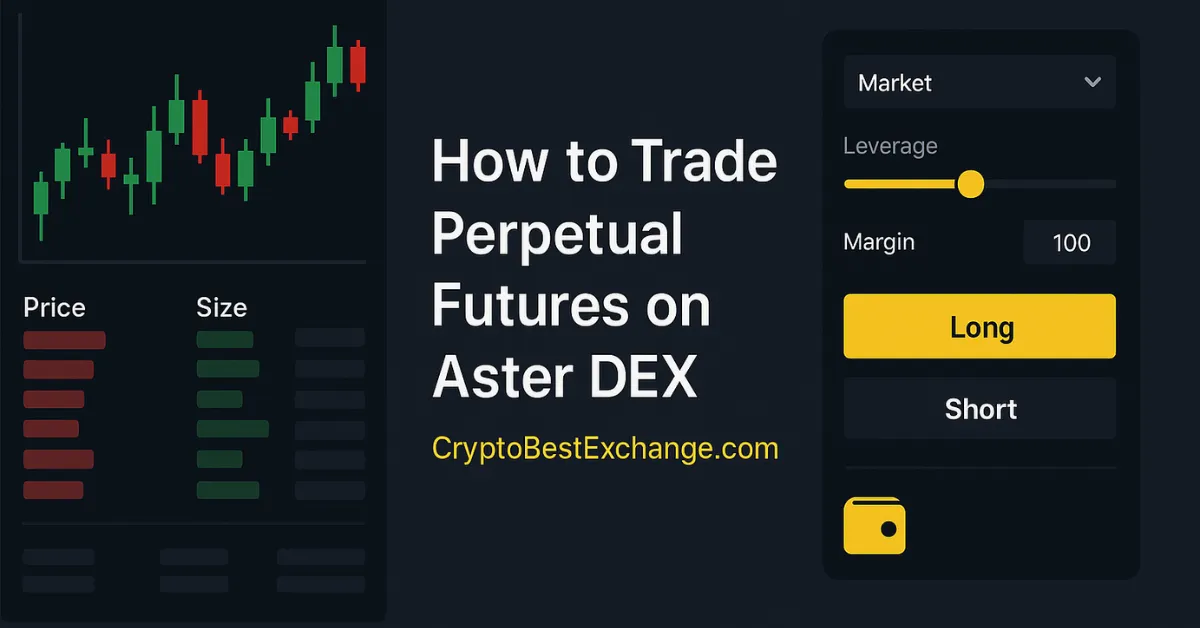
Aster DEX perpetual futures let you go long or short crypto with leverage directly from your own wallet, without handing custody to a centralized exchange. This step-by-step tutorial shows you how to trade perps on Aster safely: from wallet and network setup to choosing cross vs isolated margin, managing funding and avoiding liquidation. If you want to understand the platform in more detail before trading, you can also read our full AsterDEX review, our comparison AsterDEX vs GMX, and our overview of the best perpetual DEX exchanges.
Table of Contents
Getting Ready: What You’ll Need First
Before opening your first perpetual position on Aster DEX, you need a compatible wallet, the right network, and collateral that the protocol accepts as margin. Taking a few minutes to set this up correctly helps you avoid failed transactions and unnecessary risk later.
Wallet, Network and Funds Setup
To interact with Aster, you connect a Web3 wallet directly to the protocol. In practice, the basic setup usually looks like this:
- Choose a wallet that supports EVM chains and dApp connections (browser extension or mobile wallet via WalletConnect).
- Select the correct network inside your wallet (for example BNB Chain or another Aster-supported EVM network) before you connect.
- Fund your wallet with:
- A small balance of the chain’s native token to cover gas fees.
- Stablecoins or other supported assets that can be used as margin on Aster.
Always double-check the withdrawal network on your centralized exchange before sending funds to your wallet. Using the wrong chain is one of the most expensive beginner mistakes in on-chain perpetual trading.
Understanding Perpetuals and Leverage Risk
Perpetual futures on Aster behave similarly to perps on major futures exchanges: you can open long positions when you expect price to rise or short positions when you expect it to fall, and you can apply leverage to control a larger notional position than your margin balance.
A few key concepts to understand before you place your first trade:
- Perpetual futures don’t come with a fixed expiration date. Instead, a funding mechanism nudges the perp price toward the underlying spot price via regular payments between longs and shorts.
- Leverage boosts your profits and your losses alike. A 1% move against your position at 10x leverage is roughly a 10% hit to your margin; at very high leverage, small price moves can be enough to trigger liquidation.
- Liquidation occurs when your remaining margin is not enough to cover unrealised losses and maintenance margin requirements, so the protocol closes your position to protect the system from bad debt.
If you are new to going long and short with leverage, it is worth reading a dedicated explainer such as our guide to how long and short trading works on crypto exchanges before committing serious capital on Aster.
Setting Up Your Wallet Connection on AsterDEX
Once your wallet is funded on the correct chain, the next step is to connect it securely to the official Aster DEX interface. This process is similar to other DeFi protocols, but it is important to confirm every permission you grant.
Supported Wallets and Networks
Aster supports multiple EVM-compatible networks where its perpetual products are deployed. On the wallet side, you can typically connect via:
- Browser extension wallets that inject a provider directly into your browser.
- Mobile wallets using WalletConnect, where you scan a QR code and approve the connection on your phone.
To connect safely:
- Open the official Aster DEX URL from a trusted bookmark or the link in our AsterDEX exchange review, not from random search ads or social posts.
- Press “Connect Wallet” and select your preferred wallet option.
- Make sure your wallet is already set to a network supported by Aster perps.
- Confirm the connection request in your wallet and check that the site name and URL look correct.
If the interface shows a warning about an unsupported network, switch your wallet to the correct chain before proceeding with any approvals or trades.
Approving Tokens and Security Tips
Before a token can be used as margin on Aster, you will be prompted to approve that token. Approvals allow the smart contract to move a specified amount of that token from your wallet when you trade.
Good approval hygiene on Aster DEX includes:
- Where possible, approve only the amount you plan to trade instead of unlimited allowances.
- Review the token and contract address in your wallet’s prompt before confirming any approval.
- Periodically revoke old or unused approvals using a token approval dashboard or revoke feature inside your wallet.
For larger balances, consider using a hardware wallet, never share your seed phrase, and avoid signing transactions or messages you do not fully understand. Perpetual futures trading on Aster is already high risk; wallet security issues should not be the reason you lose funds.
Placing Your First Perpetual Trade on Aster
With your wallet connected and tokens approved, you are ready to place your first perpetual trade on Aster DEX. The workflow is similar across most markets: choose margin mode, set leverage and position size, then decide whether to use a market or limit order to open a long or short.
Choosing Cross vs Isolated Margin
Aster’s perp interface usually offers cross margin and isolated margin. Each mode changes how your risk is distributed across positions.
- Isolated margin links a fixed amount of collateral to one specific position. If that trade is liquidated, you lose only the margin allocated to that position, not your entire account balance.
- Cross margin uses your overall eligible balance as shared collateral for all open positions. This can reduce the chance that a single trade is liquidated, but it also means one large loss can drag down every other position.
For most beginners, starting with isolated margin is safer, because it forces a hard loss limit per trade. More advanced traders may choose cross margin when running hedged positions or when they actively monitor risk across a portfolio of trades.
Choosing Your Leverage and Trade Size
Next, choose leverage and notional position size. Instead of focusing only on the leverage slider, think in terms of percentage of account exposed to loss if your trade is wrong.
- Decide how much of your Aster trading balance you are willing to lose on one idea (for example 1–2%).
- Based on your planned stop-loss distance, calculate the maximum position size that keeps that loss within your risk limit at a given leverage.
- Use lower leverage on more volatile markets and avoid combining large notional positions with extreme leverage simply because the interface allows it.
Aster DEX also offers a separate 1001x rail aimed at extremely small, speculative positions. If you are curious about how it works, read our dedicated explainer on how AsterDEX 1001x mode works and treat it as a specialised tool, not the default way to size every trade.
Placing a Long or Short Order (Market vs Limit)
After you pick margin mode and leverage, you can place your actual long or short order on Aster. The basic steps are:
- Select the perp market you want to trade (for example BTC/USDT, ETH/USDT or another pair).
- Select “Long” when you think the price will go up, or “Short” when you think it will go down.
- Pick an order type:
- Market order for immediate execution at the current best price, with more slippage risk.
- Limit order for execution at a specific price or better, which may require waiting for the market to trade at your level.
- Where supported, set take-profit (TP) and stop-loss (SL) to automate exits instead of relying on full manual control.
- Review estimated liquidation price, fees and funding impact, then confirm the transaction in your wallet.
If you trade actively during the day and want to compare Aster with other venues optimised for intraday execution, check our guide to the best platforms to day trade crypto and our overview of the best crypto futures trading platforms to see where Aster fits in your broader setup.
Managing and Closing Positions
Opening a perp trade on Aster DEX is only the beginning. Your long-term results depend on how you manage open positions: monitoring PnL and funding, adjusting margin when necessary, and closing trades before liquidation becomes a real threat.
Monitoring PnL, Margin and Funding
The position panel on Aster typically displays:
- Unrealised and realised PnL, often shown in both absolute and percentage terms.
- Entry price, mark price and liquidation price for each open position.
- Margin in use and how much collateral remains available.
- A funding timer that indicates when the next funding payment will occur.
Keep an eye on these metrics, especially when funding is strongly positive or negative. Over time, funding payments can materially change the outcome of a swing trade, even if price ends up near your entry level.
How to Add or Reduce Margin Safely
Adding margin to a losing position can be part of a structured plan or a sign of emotional trading, depending on how you do it. A few guidelines for Aster traders:
- Consider adding margin only when your original thesis is still valid, but short-term volatility has pushed price temporarily against your entry.
- Avoid repeatedly adding margin to positions that have moved far past your original invalidation level just to delay liquidation.
- Use partial closes and size reductions to secure part of your profit or cut risk when volatility spikes.
Your objective is to manage risk according to a plan, not to extend losing trades indefinitely in the hope that price will revert.
Closing Positions and Avoiding Liquidation
You can usually close an Aster perp position in a few different ways:
- Using a “Close” button to submit a market order for the remaining size.
- Placing reduce-only limit orders at target prices to take profits or cut losses.
- Relying on pre-set TP/SL orders where available to exit automatically at predefined levels.
From a risk perspective, it is almost always better to exit via a planned stop-loss than to let liquidation decide your exit. Liquidations can involve extra slippage and penalties, while a stop-loss is triggered at a level you chose in advance when you were thinking clearly.
Risk Management Tips for Aster Traders
On-chain perps on Aster can be powerful tools, but they also carry significant risk. A basic risk framework will help you stay in the game long enough to benefit from experience rather than blowing up your account early.
How to Size Positions and Set Daily Loss Limits
Two simple rules go a long way when trading perpetual futures on Aster DEX:
- Risk only 1–2% of your account per trade, based on distance from entry to stop-loss.
- Define a daily maximum loss (for example 3–5% of the account). If you hit that number, stop trading and review.
These rules may feel restrictive, but they are what separate traders who can survive multiple market cycles from those who burn through their capital in a few bad days.
Avoiding Overuse of High Leverage
Aster is known for offering high leverage and an optional 1001x mode, but most traders do not need extreme gearing to be profitable. In fact, overusing leverage is one of the main reasons new Aster users get liquidated.
- Keep the majority of your trading in a moderate leverage range, especially while learning how the platform behaves.
- Treat ultra-high leverage as a small, capped part of your overall plan with predefined loss limits.
- Use chart-based invalidation levels for exits instead of targeting liquidation price as your “stop”.
To understand where Aster sits relative to other venues, you can combine this guide with our overview of top crypto futures platforms and our dedicated list of the best perpetual DEX exchanges. If you expect to generate significant volume, it is also worth exploring any AsterDEX trading fee rebate programs available to reduce your effective costs.
Common Mistakes New Aster Users Make
Most beginner losses on Aster DEX come from behaviour rather than the protocol itself. Being aware of common mistakes makes it easier to avoid them as you learn how to trade perpetual futures on-chain.
Ignoring Funding Costs and Slippage
Many new traders focus only on entry and exit price, but the real cost of trading perps on Aster includes several less obvious components:
- Funding payments can add up quickly if you hold positions in one direction during extreme sentiment.
- Slippage on market orders can turn a small intended risk into a much larger actual loss, especially on thinner markets.
- Fee structure, including any dynamic closing fees, has more impact on short-term scalping strategies than on longer-term swings.
Before scaling up, track funding rates, spreads and typical slippage on the markets you plan to trade. Aster’s design can be very competitive on cost for certain pairs and holding periods, but the details matter.
Trading with Borrowed Money or Emotional Decisions
Combining leverage with borrowed money, FOMO entries and revenge trades is one of the fastest ways to lose capital on any perp DEX, including Aster. To keep emotion in check:
- Trade only with money you can afford to lose, not funds needed for living expenses or borrowed capital.
- Define your entry, stop-loss and target before opening a position, not after the trade starts moving.
- Respect your daily loss limit and step away from the screen instead of trying to “win it back” after a big loss.
If you want to build a more robust plan that combines Aster trading with spot holdings, stablecoin reserves and other yield strategies, explore our guide to broader crypto investment strategies. In that context, Aster DEX becomes one component of a diversified approach instead of your only strategy.
Aster Perpetual Trading FAQ
There is no fixed minimum deposit to trade perpetual futures on Aster DEX, but you must have enough to cover gas fees, margin and a realistic stop-loss distance. Many beginners start with an amount they are fully prepared to lose and risk only a small percentage of that balance per trade. It is better to begin with modest capital, learn how funding, liquidations and fees behave, and then increase size later if your process proves consistent.
Aster is a decentralised protocol, so anyone with a compatible wallet can technically connect, but that does not guarantee perp trading is permitted in your jurisdiction. You are responsible for checking local laws and regulations around leveraged derivatives. The front-end may also restrict access from certain regions, so always respect geo-restrictions and comply with any guidance that Aster or your local regulator provides.
The best ways to reduce liquidations are simple but powerful: use lower leverage, keep your per-trade risk small relative to your account, and set a clear stop-loss instead of letting liquidation act as your exit. Avoid stacking too many correlated positions on the same volatile asset, pay attention to funding, and review any trade that ends in liquidation to understand whether position size, entry timing or emotional decision-making were the real problem.
No. You can get most of the benefits of Aster DEX by using its standard perpetual futures with moderate leverage, non-custodial margin and multi-chain access. The 1001x mode is an optional feature designed for very small, tightly controlled speculative trades. Most traders are better off treating it as a niche tool for specific ideas rather than a setting to use on their full account balance.

 Crypto Trading Platforms & Apps
 Best Crypto Trading Apps & Platforms
 Crypto Futures & Leverage Trading
 Buying & Selling Crypto
 Automated & Software Trading