

AsterDEX is a new high-leverage perp DEX that’s gaining search interest fast, thanks to its low fees, deep liquidity and up to 1001x leverage for aggressive traders. In this AsterDEX review, CryptoBestExchange explains how the exchange really works – from trading modes and fee structure to yield features and security – so you can decide if AsterDEX deserves a spot in your futures trading setup.
Table of Contents
AsterDEX Overview: Core Design and Trading Modes

AsterDEX (often written as Aster DEX) is a perp-first, on-chain exchange that lets you trade both perpetual futures and spot markets across multiple EVM-compatible networks. Instead of working like a traditional centralized exchange (CEX) where you deposit funds into an internal account, AsterDEX connects directly to your wallet, routes orders through smart contracts and settles everything on-chain. That means you keep custody of your assets while still getting an experience that feels close to a pro derivatives platform.
At its core, AsterDEX is built around three main trading modes: Perpetual Pro, 1001x and Spot. Perpetual Pro gives you a classic orderbook futures interface, with limit/market orders, cross and isolated margin, and leverage that’s high enough for most professional traders. The 1001x mode is a separate “degen” rail that pushes leverage to the extreme and experiments with a different fee model, designed for very small, highly speculative positions. Spot mode covers standard crypto spot trading, giving you on-chain access to major pairs without leverage.
On top of these trading modes, AsterDEX plugs into a broader yield and incentive layer: collateral types like USDF and asBNB are designed to earn yield while being used as margin, and the platform runs VIP tiers, campaigns and referral rewards to attract both volume and liquidity. The result is a hybrid between a perp DEX, a yield platform and an incentive machine — which can be powerful for active traders, but also adds extra layers of complexity and risk you need to understand before going all-in.
Perpetual Pro vs 1001x vs Spot
From a trader’s point of view, the three AsterDEX modes behave very differently. Perpetual Pro is the “standard” experience most futures traders will recognize: you get an orderbook interface, depth, visible limit orders and tools like cross/isolated margin, configurable leverage and advanced order types. It’s built for active, experienced derivatives traders who care about execution quality, managing risk with stop orders, and running strategies that don’t require insane leverage. The main pros are control and transparency; the cons are that you still face usual perp risks like funding, liquidations and on-chain volatility.
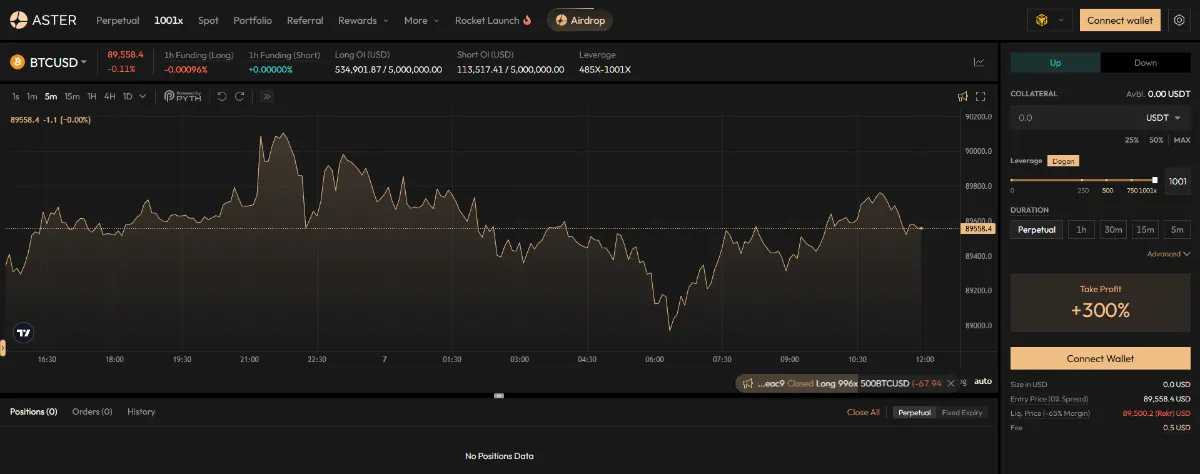
The 1001x mode is a deliberately experimental, ultra-aggressive rail. It supports only a few key markets (typically BTC and a couple of majors) and lets you push leverage up to 1001x on selected pairs. It’s meant for tiny, “lottery ticket” positions where you risk a small slice of capital for outsized upside. In some configurations you pay no fee to open, but a dynamic closing fee based on your PnL. The upside is obvious: extreme gearing and big win potential. The downside is just as clear: even small price moves can liquidate you, closing fees can jump on large winners, and this mode is not suitable for beginners or sizeable account balances.
Finally, Spot mode is the most straightforward of the three. It lets you buy and sell assets without leverage, using a more traditional spot orderbook or swap-like interface depending on the pair. This is best suited for traders who want to build or rebalance spot portfolios, move in and out of stablecoins, or hedge perp exposure without adding more leverage. The main advantage is simplicity and lower risk compared to futures; the drawback is that you don’t get the capital efficiency of margin, so it’s less interesting for pure short-term speculators.
In practice, most serious users will treat Perpetual Pro as their main workhorse, use Spot for entry/exit and hedging, and only touch 1001x with very small, predefined risk. Understanding which mode fits your profile — and when to avoid the others — is key to using AsterDEX intelligently instead of letting the platform’s degen features use you.
AsterDEX Trading Fees and Funding Rates
AsterDEX Perpetual Pro fees at a glance
Fee schedule and funding logic for the Pro orderbook interface.
Base maker / taker fees
| Order type | Fee | Notes |
|---|---|---|
| Maker | 0.005% | Limit orders that add liquidity to the book. |
| Taker | 0.040% | Market/IOC orders that remove liquidity. |
Fees are charged on the notional position size (contracts × price) and deducted from your margin balance.
VIP tiers & discounts
| Tier | 30-day volume | Maker | Taker |
|---|---|---|---|
| Standard | < 100,000 USDT | 0.005% | 0.040% |
| VIP 1 | > 100,000 USDT | 0.005% | 0.038% |
| VIP 2 | > 1,000,000 USDT | 0.002% | 0.035% |
| Referral code | Any volume | Extra 5% fee discount when paying with $ASTER. | |
VIP status is recalculated daily based on rolling 30-day volume.
Funding rates on AsterDEX Pro
- Funding is exchanged directly between long and short traders – AsterDEX itself does not earn funding fees.
- On Pro mode, funding is settled hourly based on a premium index that compares perp prices with the spot index.
- The funding rate = premium index + fixed daily interest (0.03%).
- Positive funding: longs pay shorts. Negative funding: shorts pay longs.
- Funding amount = position size × mark price × funding rate.
For high-leverage 1001x “Simple” mode, Aster uses a different fee model with flat open/close fees and per-block funding – this table focuses on the Pro orderbook interface only.
Like any perpetual exchange, AsterDEX makes money through a mix of trading fees and funding payments. As a trader, your real cost per trade comes from three layers:
- Perpetual Pro fees (maker/taker + funding)
- 1001x mode fees (opening, closing and liquidation-specific behavior)
- Spot trading fees, which can be reduced via VIP tiers and ASTER holdings
Understanding how these work together lets you compare AsterDEX against other low-fee platforms and avoid nasty surprises when fees eat into your PnL. If you’re evaluating exchanges mainly on trading costs, you should also look at our broader guide to low-fee crypto exchanges.
Perpetual Pro Fees
In Perpetual Pro, AsterDEX uses a familiar maker/taker fee model:
- Maker orders add liquidity to the orderbook (limit orders that don’t fill immediately).
- Taker orders remove liquidity (market orders or limits that fill right away).
In practice:
- Maker fees are usually lower than taker fees, rewarding traders who provide liquidity.
- Fees are calculated as a percentage of your notional position size, for both opening and closing: Fee = Notional size × fee rate
For example, a 10,000 USDT position with a 0.05% trading fee would cost 5 USDT on entry and another 5 USDT on exit (numbers just for illustration).
On top of that, you pay (or receive) funding:
- A positive funding rate means long positions pay funding to short positions.
- A negative funding rate means short positions pay funding to long positions.
- Funding is charged periodically based on the difference between the perp price and the spot index.
If you hold positions for several hours or days, funding can easily exceed your entry/exit fees, so it’s crucial to watch the funding rate and countdown timer before committing to swing trades on AsterDEX.
1001x Mode Fees (Opening, Closing and Liquidation)
The 1001x mode on AsterDEX has its own fee logic to match its “high-risk, high-leverage” design.
In the standard 1001x mode you’ll typically see:
- A trading fee when opening the position
- A trading fee when closing the position
- A small execution fee to cover on-chain transaction costs (varies by network)
In the more aggressive “Degen mode”, the structure is different:
- You often pay no fee to open a position, which encourages small speculative bets.
- You pay a dynamic closing fee calculated as a share of your PnL, with a minimum fee (for example, a floor like 0.03% of notional).
- Small or losing trades tend to pay a relatively low fee.
- Big winning trades can pay a higher closing fee because it’s tied to realized profit.
Because leverage can reach up to 1001x on selected markets, liquidation risk is extreme:
- Even tiny price moves can push your margin below the maintenance level.
- When a 1001x position is liquidated, you can lose most or all of the initial margin you put into that trade, and fees may still apply according to the liquidation rules.
The takeaway: 1001x is designed for very small, highly speculative positions, not for parking your main trading capital. Always test with tiny size first so you understand how the fee and liquidation behavior feels in practice.
Spot Trading Fees and VIP Discounts
In Spot mode, fee logic is simpler:
- Each filled trade incurs a spot trading fee, usually using the same maker/taker concept or a flat spot rate depending on the pair.
- There is no funding and no liquidation on spot trades — your cost is essentially spot trading fees + network costs.
Where AsterDEX gets more interesting is with VIP tiers and ASTER token discounts:
- VIP status is typically calculated from:
- Your rolling 14-day trading volume (spot + perp, converted to USD), and
- Your average ASTER token balance over the same period.
- Higher VIP tiers can:
- Reduce spot trading fees
- Also improve perpetual fees and boost your share of certain rewards or campaigns
For high-volume traders, stacking:
- Lower base fees on AsterDEX pairs
- VIP tier discounts
- Potential referral or cashback deals if you sign up through partners like CryptoBestExchange
…can push your effective fee per trade significantly below the headline rates shown in the default fee table.
Leverage, Markets and Trading Conditions
Supported Perpetual and Spot Markets
On AsterDEX, you’re not locked into a single asset type or chain – the exchange is built around a multi-chain, multi-market approach:
- Perpetual markets
AsterDEX focuses first on perps for:- Major coins like BTC, ETH and other large-cap “blue chips”
- High-liquidity altcoins in sectors like DeFi, L1/L2 infrastructure and AI
- Select meme coins and “hot narrative” tokens when liquidity and volatility justify it
- Spot markets
In Spot mode, you can trade:- Core pairs such as BTC/USDT, ETH/USDT and other majors
- Stablecoin pairs and route assets into USDF or other yield-bearing collateral
- Additional altcoin pairs depending on which networks and pools are live
AsterDEX is designed for EVM-compatible chains, so you’ll typically see different market subsets available on networks like BNB Chain, Arbitrum and others. When you connect your wallet, the app will show which perp and spot markets are currently tradeable on that specific network – always check the in-app market list before deciding where to bridge or deposit.
Maximum Leverage and Margin Modes
AsterDEX gives traders a wide leverage spectrum, from conservative to outright degen:
- Perpetual Pro leverage
- Offers “normal” high leverage suitable for most pro traders (for example 10x–100x ranges depending on the pair).
- You can switch between isolated margin and cross margin:
- Isolated margin: only the margin assigned to that position is at risk; easier to compartmentalise trades.
- Cross margin: your available balance backs all positions together, which can reduce liquidation risk on one trade but expose more of your capital if things go wrong.
- 1001x mode leverage
- On selected pairs (often BTC and a small set of majors), you can dial leverage up to hundreds of times – in some configurations all the way to 1001x.
- This mode assumes you are using very small position sizes and accepts that tiny price moves can trigger liquidations.
- Margin rules are stricter: initial margin is tiny, maintenance margin is tight, and you usually cannot add margin after the fact in degen configurations.
In both modes, your required margin is calculated from:
Required margin = (Notional position / Leverage) + any additional buffers in the system
A simple mental rule:
- If you’re thinking in terms of risk per trade (% of account you’re willing to lose if liquidated), you’ll often find that 5–20x leverage on Perpetual Pro is more than enough for directional trading.
- The 1001x rail is best treated as a specialist tool for tiny, predefined-risk bets rather than a default setting.
Order Types, Hidden Orders and MEV Protection
AsterDEX tries to give you the feel of a professional derivatives venue while still running on-chain:
- Core order types
- Market orders: fill immediately at the best available price; you pay taker fees and accept slippage.
- Limit orders: set a price where you’re willing to buy or sell; they can act as maker orders if they rest on the book.
- Stop / take-profit style orders (where available): help you automate exits and reduce the need to babysit positions.
- Hidden (invisible) orders on Perpetual Pro
Perpetual Pro supports hidden orders that do not appear openly in the orderbook. That means:- Other traders and bots can’t see your resting size or price levels.
- You can execute larger trades more discreetly, which is helpful for size-sensitive strategies.
The trade-off is that hidden orders may have different matching priority compared to visible maker orders, depending on the matching engine rules.
- MEV and slippage controls
Because AsterDEX settles on-chain, it needs to care about MEV (miner/validator extractable value) and sandwich attacks on large trades. The platform is built with:- Routing and pricing logic aimed at reducing the chance of your transaction getting sandwiched.
- Clear slippage settings so you can cap how far the execution price is allowed to move from your quote.
- The ability to choose networks and pairs where liquidity is deep enough that slippage and MEV impact are naturally lower.
When you combine these three elements – diverse markets, flexible leverage and pro-style order tools – AsterDEX can feel very close to a CEX for active traders. The key difference is that you’re trading under on-chain constraints, so understanding slippage, execution latency and margin behavior is essential before you scale up your position size.
Aster DEX Security, Audits and Risk Factors
Smart Contract Audits and Custody Setup
Because AsterDEX is an on-chain exchange, your funds are ultimately controlled by smart contracts and wallets, not by a traditional centralized custodian. That has two sides:
- You avoid classic CEX risks like “exchange runs away with deposits”,
- But you take on contract and protocol risk instead.
The team behind AsterDEX publishes smart contract audit reports and security notes in its documentation. These typically cover:
- Core trading contracts (perpetual engine, 1001x module, spot/AMM components)
- Collateral and yield contracts (for stablecoins or yield-bearing tokens used as margin)
- Any vaults or staking products that hold user funds on behalf of the protocol
As a trader, don’t just assume “audited = safe”. It’s worth checking:
- How many audits exist and how recent they are
- Whether issues were found and how they were resolved
- If the protocol uses multisig, time-locks, or other controls over admin keys and contract upgrades
In plain terms: AsterDEX aims to reduce custody risk by keeping settlement on-chain and using audited contracts, but you are still delegating trust to the code, oracles and upgrade mechanisms that run the protocol.
On-Chain Risks: Smart Contracts, Oracles and Liquidations
Even with audits, AsterDEX carries the same on-chain risks as any perp DEX — plus some extra risk from its ultra-high leverage features.
Key risk buckets to understand:
- Smart contract risk
- A bug in trading, vault or margin contracts can lead to stuck funds, bad accounting or loss of collateral.
- Complex systems (perps + yield + custom stablecoins) have more moving parts and therefore more potential attack surfaces.
- Oracle and pricing risk
- AsterDEX relies on price feeds (oracles and/or external exchanges) to compute index prices, funding and liquidation levels.
- If an oracle is manipulated, delayed or fails, traders can face unfair liquidations or mispriced entries/exits, especially at high leverage.
- Liquidation cascades
- On leveraged platforms, sharp moves can trigger a wave of liquidations, increasing volatility and slippage.
- With leverage settings that can go as high as 1001x, even a tiny wick can wipe out over-extended traders and cause extra selling pressure into thin liquidity.
- Collateral and depeg risk
- If you use yield-bearing tokens or protocol-specific stablecoins as margin, you also take on depeg and strategy risk:
- If the asset loses its peg or underlying strategy fails, your margin can evaporate even if your trade direction was correct.
- If you use yield-bearing tokens or protocol-specific stablecoins as margin, you also take on depeg and strategy risk:
If you’re not sure how to evaluate these risks or compare exchanges, it’s worth reading a broader framework on how to spot legit vs scam crypto platforms in our dedicated guide.
Regulatory Risks and Geo-Blocks
While AsterDEX feels permissionless at the UI level — connect a wallet and start trading — derivatives and high-leverage products are heavily regulated in many countries. That creates an extra layer of “off-chain” risk:
- Some jurisdictions restrict or outright ban retail access to leveraged crypto derivatives.
- A DEX front-end can implement geo-blocks or service limitations if regulators start to focus on it.
- Your trading activity may be subject to reporting and tax obligations, even if there is no KYC on the protocol itself.
AsterDEX is not your lawyer or tax advisor, and neither is this review. Ultimately:
- It’s your responsibility to check whether perpetual futures and high leverage are allowed where you live.
- You should keep your own records and speak with a qualified professional about tax and regulatory obligations in your jurisdiction.
Security on AsterDEX is not just about code and audits; it’s also about whether you’re trading in a way that’s legally and financially sustainable for your situation.
USDF, asBNB and Aster Earn: Trading While You Earn Yield

What Is USDF and How Is It Collateralized?
On AsterDEX, USDF is designed as a yield-bearing stablecoin rather than a simple “parked” dollar token. The idea is that instead of holding idle USDT or another stable in your wallet, you convert into USDF and let the protocol put that capital to work in low-risk, diversified strategies.
At a high level, USDF is intended to:
- Track 1:1 against a major stablecoin (typically USDT or a basket of stablecoins)
- Be fully collateralized, so that redemptions back to the base stable are always possible under normal conditions
- Pass through a portion of the strategy yield to USDF holders, which is why your balance can grow or accrue rewards over time
Redemption usually works both ways:
- You mint USDF by depositing the underlying stable into the protocol.
- You can later redeem USDF back into the underlying, subject to liquidity and protocol rules.
For risk management, you should think of USDF as:
- Less risky than an uncollateralized token,
- But not risk-free, because it depends on smart contracts, the underlying stablecoin(s) and the yield strategies used under the hood.
asBNB and Other Yield-Bearing Collateral
Alongside USDF, AsterDEX uses yield-bearing collateral tokens such as asBNB and asUSDF:
- asBNB represents BNB that has been deposited into Aster’s yield system. Instead of just holding BNB in your wallet, you convert to asBNB and:
- Keep exposure to the underlying BNB price
- Earn yield from strategies (for example, staking, incentive programs or liquidity mining)
- Use asBNB as margin for perpetual trading on AsterDEX
- asUSDF plays a similar role for USDF:
- You lock USDF into Aster Earn or a vault
- In return, you receive asUSDF, which reflects your claim on the principal plus accrued yield
- asUSDF can often be used as collateral for trading or other on-platform activities
This creates a loop where your margin is never truly idle:
- You can open and manage perp positions using collateral that is earning yield in the background
- Your effective trading cost (after factoring in yield) can be lower than the headline fee and funding rates suggest
The flip side is that you are stacking risks: market risk, leverage risk and collateral/yield-strategy risk all at once.
How Aster Earn Works (CeDeFi Yield Strategies)
Aster Earn is the yield layer that ties these tokens together. It follows a CeDeFi approach – combining DeFi-style smart contracts with curated, CeFi-style strategies – to simplify yield generation for users who don’t want to manage multiple protocols themselves.
In practice, Aster Earn aims to:
- Allocate your deposits into pre-selected yield strategies (for example, lending markets, liquidity pools or conservative delta-neutral trades)
- Auto-compound rewards so that returns scale over time without manual reinvestment
- Offer on-demand liquidity for supported assets, so you can redeem or reallocate into trading when market conditions change
From a trader’s perspective, the main benefits are:
- You can park idle capital in Aster Earn and move it into margin when a trade appears, instead of letting it sit in a zero-yield stablecoin.
- You can build a hybrid approach where part of your portfolio is in yield strategies and another part is actively trading perps.
If you’re interested in building a broader, long-term yield strategy beyond AsterDEX itself, it’s worth comparing these CeDeFi yields with other opportunities covered in our guide to best long-term crypto investments for 2025.
Referral Program and Incentives for Active Traders
Referral Commission Rates and Payout Rules

AsterDEX runs a referral program so active users and KOLs can earn a share of the trading fees generated by their audience. The baseline structure is usually:
- A base commission rate (for example, around 10% of eligible trading fees) that every approved referrer can earn
- The ability to move to higher tiers with larger commission splits once you hit certain volume or performance thresholds
Key points to understand before you start pushing a referral link:
- Only eligible trading volume counts toward commission – self-trading, wash trading or zero-fee/promotional volume is typically excluded.
- Payouts are usually made in the same asset that the referred trader paid in fees (e.g., USDT, BTC, etc.).
- There is often a cookie window (for example, up to 365 days) during which a referred user’s activity is linked to your account.
AsterDEX also enforces anti-abuse rules: using multiple accounts to refer yourself, setting up artificial volume loops, or misleading users about risk can lead to commission clawbacks and removal from the program. If you plan to promote AsterDEX seriously, treat the referral program as a long-term revenue share, not a short-term exploit.
VIP Program and Trading Volume Requirements
Beyond referrals, AsterDEX uses a VIP system to reward traders who bring consistent volume and hold the native ASTER token.
Typical VIP logic looks like this:
- Your tier is calculated based on a combination of:
- Rolling 14-day trading volume, often measured in USD equivalent across spot and perps
- Your average ASTER holdings over the same period (snapshot taken at regular intervals)
- As you climb higher VIP tiers, you can unlock:
- Lower trading fees on both spot and perpetual markets
- Enhanced reward multipliers in campaigns, sometimes better maker rebates or priority in new features
For high-volume traders, this creates a flywheel:
- Trade more and/or hold more ASTER → rise in VIP tier
- Pay less in fees per trade
- Lower effective costs make it easier to sustain or increase volume
The key is to calculate whether the fee savings and extra rewards justify any extra exposure you take on by holding ASTER as part of your trading stack.
Points, Campaigns and Airdrop Potential
On top of structural incentives, AsterDEX leans heavily into campaigns, points systems and seasonal events to attract both traders and liquidity:
- Points / stages – trading volume, liquidity provision or specific actions (such as trying new features like 1001x or using yield products) can earn points that later convert into:
- Token rewards
- Fee discounts
- Access to special events or whitelists
- Trading competitions and leaderboards – short-term events where top traders by PnL or volume receive:
- Extra ASTER rewards
- Boosted referral multipliers
- Exclusive NFTs or badges for reputation
- Airdrop potential – in the early and growth stages, protocols like AsterDEX often allocate part of their token supply or fee revenue to:
- Reward early, consistent users
- Incentivize specific behaviors (e.g. providing deep liquidity on certain pairs, using particular networks, or testing new products)
If you’re primarily hunting for fee rebates and incentive structures across multiple platforms, it’s worth placing AsterDEX in context by comparing its offers with other exchanges covered in our dedicated guide to crypto fee rebate programs.
Who Should (and Shouldn’t) Use AsterDEX?
Best for High-Volume and High-Leverage Traders
AsterDEX is built first and foremost for experienced, active traders who are comfortable with leverage, on-chain execution and a more complex risk stack. It’s a natural fit if:
- You trade perpetual futures frequently and care about tight execution, low effective fees and flexible margin.
- You understand how to size positions, manage funding costs and avoid liquidation cascades.
- You’re willing to experiment with tools like USDF, asBNB and yield-bearing collateral to squeeze more efficiency out of your capital.
- You treat the 1001x mode as an optional, high-risk tool for tiny, predefined-risk bets – not as a way to “shortcut” proper risk management.
For this profile of trader, AsterDEX can be attractive because it combines:
- Perp DEX mechanics (non-custodial, transparent, multi-chain)
- With CEX-like features (orderbook, hidden orders, VIP tiers)
- And an extra yield and incentive layer that can reduce your effective cost per trade over time.
If you already juggle multiple perp platforms and are comfortable reading fee tables, funding dashboards and on-chain risk disclosures, AsterDEX is the kind of exchange that can slot into your existing futures toolkit.
When a Centralized Exchange Might Be Safer
On the other hand, AsterDEX is not the ideal starting point for everyone. A more traditional centralized exchange might be safer if you:
- Are a beginner still learning how long/short, leverage and liquidation work
- Primarily trade with larger capital that you can’t afford to expose to smart contract or oracle issues
- Need seamless fiat on- and off-ramps, simple KYC and integrated bank/credit card deposits
- Don’t want to manage wallets, gas fees, network switches and on-chain approvals
You’ll typically get the following from centralized exchanges:
- A more hand-held, step-by-step onboarding experience
- Lower cognitive load (fewer moving parts than a perp + yield + multi-token collateral stack)
- Rich educational content, demos and basic account protections
If you recognise yourself in this second group, you may be better off starting on a user-friendly CEX first. Our guide to choosing the best crypto exchange for beginners is a good place to find more suitable options before you graduate to on-chain derivatives platforms like AsterDEX.
Final Verdict: Is AsterDEX Worth Trying in 2025?
AsterDEX is clearly not a generic, beginner-friendly exchange – it’s a high-leverage, incentive-heavy perp DEX aimed at traders who already understand how derivatives, funding and on-chain risk work. On the plus side, you get: powerful Perpetual Pro trading, the headline-grabbing 1001x mode, yield-bearing collateral like USDF and asBNB, and a referral/VIP system that can make your effective fees very competitive if you trade decent volume. On the minus side, you’re stacking smart contract, oracle and liquidation risk, especially if you push leverage too far or park too much capital in yield strategies you don’t fully understand.
If you decide to try AsterDEX, the key is risk management first, features second:
start with small position sizes, ignore 1001x until you’re comfortable with the Perpetual Pro engine, and treat USDF/asBNB as tools to optimise capital – not magic yield. Used responsibly, AsterDEX can be a valuable addition to a pro trader’s futures toolkit, especially for those who already split volume across several perp platforms. If you’re still weighing your options, it’s a good idea to compare with other futures platforms in our best crypto futures exchanges guide.
This AsterDEX review is part of CryptoBestExchange’s ongoing coverage of low-fee futures platforms.
Aster DEX FAQ
AsterDEX uses smart contracts, audits and on-chain settlement instead of holding your funds in a centralized account, which removes classic “exchange custody” risk. However, there is still smart contract, oracle and market risk, especially on leveraged products and yield strategies. For that reason, it’s generally not wise to go all-in on a single protocol or keep your entire trading bankroll parked on AsterDEX.
In most cases, you can start using AsterDEX by simply connecting a compatible wallet and funding it on a supported network, without going through a traditional KYC process. That said, derivatives and high-leverage products are heavily regulated in many countries, and you are responsible for complying with the laws, tax rules and reporting requirements that apply in your own jurisdiction.
Although AsterDEX offers leverage up to 1001x on certain markets, most traders will be better off staying in the 5x–20x range on Perpetual Pro, with clearly defined stop-loss levels and position sizing. The ultra-high 1001x mode is best treated as a niche tool for very small, predefined-risk trades, not as a default setting for your main account balance.
Yes. AsterDEX lets you use yield-bearing assets such as USDF and asBNB as margin, and it offers Aster Earn strategies that generate additional yield on idle capital. This means you can combine perpetual trading with passive returns on your collateral. Keep in mind, though, that stacking yield, leverage and protocol risk increases your overall exposure, so you should size positions and deposits accordingly.
Nothing in this AsterDEX review is financial advice. Make sure you do your own research and only risk money you can afford to lose.
Want real-time updates on AsterDEX and other low-fee futures platforms? Join the CryptoBestExchange Telegram here: https://t.me/cryptobestexchangecom
 Crypto Trading Platforms & Apps
 Best Crypto Trading Apps & Platforms
 Crypto Futures & Leverage Trading
 Buying & Selling Crypto
 Automated & Software Trading