
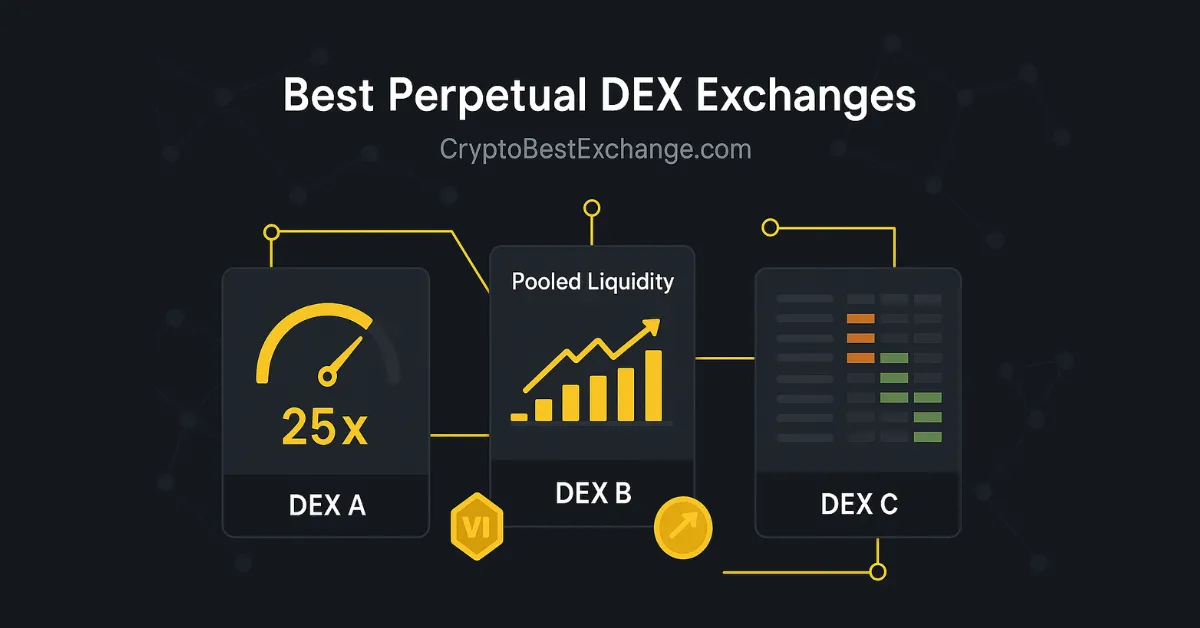
The rise of on-chain derivatives means serious traders now have real alternatives to centralized futures platforms. The best perpetual DEX exchanges combine high leverage, deep liquidity and transparent smart contracts, while letting you keep control of your wallet at all times. In this guide, we highlight leading perp DEXs such as Aster, GMX and dYdX, explain how they differ, and show you how to match each platform to your own risk profile.
We’ll look at fees, leverage limits, liquidity, security and user experience, then finish with a practical checklist and FAQ so you can decide which perpetual DEX – or combination of DEXs – fits your trading style best.
Table of Contents
Why Trade Perpetual Futures on DEXs?
On-chain perpetual futures are designed to give you CEX-level trading tools without handing your assets over to a centralized custodian. Before choosing among the best perpetual DEX exchanges, it’s worth understanding why many traders are shifting some of their leverage activity on-chain.
Why Perpetual DEXs Beat Centralized Exchanges
Perpetual DEXs offer a mix of benefits that centralized platforms can’t always match:
- Non-custodial control – Your funds stay in your own wallet or in audited smart contracts, not in a centralized account that can be frozen or mismanaged.
- On-chain transparency – Positions, liquidations and fee flows are visible on-chain, which makes it easier to audit how the protocol behaves during volatile markets.
- Reduced KYC friction – Many perp DEXs only require a wallet connection, not full identity verification, though you still have to respect local regulations yourself.
- Global accessibility – As long as you can access the supported networks and front-ends, you can typically trade from anywhere that doesn’t block the interface.
That said, centralized exchanges still have their place – especially for fiat on/off-ramps, large spot orders and beginners who want a simpler interface. If, after reading this, you realise you still prefer a traditional platform, you can compare options in our guide to the best crypto exchanges.
Key Risks of On-Chain Perpetuals
Perpetual DEXs solve some problems but introduce new ones. The main risks include:
- Smart contract risk – Bugs, exploits or design flaws in the protocol contracts can lead to loss of funds.
- Oracle and pricing risk – If price feeds are manipulated or fail during extreme volatility, liquidations and PnL can be affected.
- Liquidity risk – Some markets are still thin; large orders may suffer heavy slippage or be impossible to execute at your desired size.
- Network risk – Congestion, high gas fees or chain outages can make it difficult to adjust positions in fast markets.
Choosing among the best perpetual DEX exchanges is therefore about balancing self-custody and transparency against technical and liquidity risks that simply don’t exist in the same way on big CEXs.
How We Rank Perpetual DEX Platforms
Before diving into individual protocols, it helps to understand the criteria we use when evaluating the top perpetual DEXs.
Fees, Leverage and Liquidity
For active perp traders, three core variables matter most:
- Fee structure – Maker/taker rates, execution fees, funding and any hidden costs such as dynamic closing fees or borrowing charges.
- Leverage limits – How far you can gear your positions, and whether the limits are realistic or “casino-level” for marketing only.
- Liquidity and slippage – Depth on major pairs like BTC and ETH, plus how the platform handles larger orders and long-tail markets.
The best perpetual DEX exchanges don’t just offer big headline leverage; they combine reasonable fee levels with reliable execution on the pairs traders actually use.
Security Standards, Audit History and Performance Track Record
We also look at:
- Audit history – Whether the protocol has undergone reputable security audits and how often those reviews are updated.
- Operational track record – How the DEX has behaved through major market events, including volatility spikes and liquidity stress.
- Risk controls – Use of insurance funds, robust liquidation engines and clear documentation of protocol parameters.
With that framework in mind, let’s look at three of the best perpetual DEX exchanges today: Aster DEX, GMX and dYdX, plus a few smaller platforms worth tracking.
Aster DEX: High-Leverage, Yield-Native Perp DEX
Key Features and Target Traders
Aster DEX is built for traders who want an on-chain futures toolbox with higher leverage and more capital-efficiency features than most perp DEXs.
- 1001x mode – A separate ultra-high-leverage rail for tiny, speculative positions on selected markets.
- Perpetual Pro – A more conventional perp engine with cross/isolated margin and a CEX-like orderbook interface.
- Yield-native collateral – Assets like USDF and asBNB are designed to earn yield while also serving as margin.
- Multi-chain support – Deployed on EVM networks such as BNB Chain and other L2s, making it attractive to multi-chain traders.
Aster DEX is best suited to active leverage traders who already understand liquidation mechanics and are comfortable juggling perps, yield products and multiple chains in one strategy.
Pros and Cons for Active Leverage Traders
Key advantages and trade-offs:
- Pros:
- Very high leverage ceiling via 1001x mode for “lottery-ticket” trades.
- Yield-native collateral can improve capital efficiency if used carefully.
- CEX-style orderbook layout feels familiar to centralized futures traders.
- Cons:
- Higher structural complexity (yield layers, multi-chain, 1001x) means more moving parts to manage.
- Newer protocol risk compared with older perp DEXs.
- Not ideal for complete beginners who are still learning leverage basics.
To dig deeper into fee schedules, risk controls and ecosystem incentives, you can read our full Aster DEX review before committing serious capital.
GMX: Battle-Tested Perpetual DEX with Deep Liquidity
Core Features and Liquidity Model
GMX is one of the most established perpetual DEXs, known for its GLP pooled-liquidity model and strong community of traders and LPs.
- GLP index pool – A basket of assets that backs perp and swap markets; traders go long or short against this pool.
- Fee sharing – A large share of trading fees and funding is distributed to GMX stakers and GLP holders.
- Moderate leverage – Leverage caps are conservative compared with Aster’s 1001x rail, focusing on sustainability.
- Multi-chain presence – Historically strong on networks like Arbitrum, with deployments on other chains.
GMX appeals to traders who want a DeFi-native perp experience with transparent economics between traders and LPs, rather than extreme leverage or complex yield layers.
Pros and Cons
Consider the following when evaluating GMX against other top perpetual DEX exchanges:
- Pros:
- Long operational track record and strong reputation in the DeFi perp space.
- Transparent revenue-sharing model for GMX and GLP holders.
- Generally solid depth on major pairs backed by substantial TVL.
- Cons:
- Leverage is intentionally capped at moderate levels, which may frustrate “degen” traders.
- Market list is more curated, so fewer exotic narrative or meme perps.
- GLP holders take on inventory and directional risk in the underlying asset basket.
GMX works particularly well as a core on-chain perp venue for traders who value stability, clarity and deep liquidity over maximum leverage.
dYdX: Orderbook Experience for Perp Traders
Trading Experience and Supported Markets
dYdX has long been a go-to name for traders seeking a professional orderbook experience in a non-custodial environment. Over time, it has evolved from a layer-2 solution into a dedicated chain, designed specifically for high-performance derivatives trading.
- CEX-like interface – Advanced order types, depth charts, and familiar layout for professional traders.
- Wide market coverage – A broad list of perp pairs, especially on major and mid-cap assets.
- Performance-focused architecture – Built to support high throughput and low latency trading.
For traders coming from centralized futures platforms, dYdX often feels like the closest on-chain approximation in terms of speed and interface sophistication.
Pros and Cons
Key points when comparing dYdX to other leading perpetual DEX exchanges:
- Pros:
- Highly refined trading UI and features set aimed at experienced perp traders.
- Strong liquidity on major markets, suitable for larger order sizes.
- Non-custodial design with an emphasis on performance and reliability.
- Cons:
- Complexity can overwhelm beginners who aren’t used to professional futures tools.
- Regulatory and regional access constraints may limit some users, who might still need CEXs tailored to their jurisdiction.
- Requires some comfort with chain-specific wallets and bridging flows.
For traders in regions like the UK who still require a strong centralized platform for fiat flows plus perp exposure, it can make sense to pair dYdX with a regulated exchange from our guide to the best cryptocurrency exchanges for UK users.
Other Notable Perpetual DEXs to Watch
Niche Perp DEXs with Standout Features
Beyond Aster, GMX and dYdX, there are other perp DEXs pushing interesting design choices – for example, platforms focusing on:
- Cross-margin across multiple assets with shared risk pools.
- Options-like payoff structures built on top of perps.
- Specialised narrative markets such as real-world assets or niche sectors.
These smaller DEXs can be attractive for specific strategies or early-adopter rewards, but they typically come with higher smart contract and liquidity risk. For most traders, they work best as small satellite allocations rather than primary venues.
How to Choose the Right Perpetual DEX for Your Strategy
Matching Fees and Leverage with Your Risk Profile
When deciding which of the best perpetual DEX exchanges to use, start from your risk tolerance and trading style rather than from marketing promises:
- If you need maximum leverage and yield-native collateral, Aster DEX may offer the most flexibility – but requires strict discipline.
- If you want a balanced, fee-sharing perp platform with moderate leverage and deep liquidity, GMX is often a solid core choice.
- If you prioritise a pro-grade orderbook feel and broad market coverage, dYdX may be the right fit.
It’s often smarter to use two or three DEXs in combination rather than forcing all your trading into a single protocol.
Testing Platforms with Small Positions First
Whatever you choose, treat your first trades as live tests rather than full-size bets:
- Start with small position sizes to see how funding, slippage and liquidations behave.
- Try different order types and timeframes before scaling up.
- Consider using bots or semi-automated strategies only after you fully understand how the DEX executes under stress.
If you’re exploring automation, our guide to the best crypto trading bots for day trading can help you compare bot frameworks before connecting them to on-chain perp platforms.
Perpetual DEX FAQ
Perpetual DEXs are safer in some ways and riskier in others. You avoid custodial risk because your assets stay in your wallet or in audited smart contracts, and on-chain transparency makes it harder to hide bad behaviour. However, you take on smart contract, oracle and network risk that do not exist in the same way on large centralized platforms. For many traders, the best approach is to combine both: use DEXs for non-custodial leverage and CEXs for fiat access and deep spot liquidity.
There is no single “best” perpetual DEX for beginners, but some are more forgiving than others. Protocols like GMX and dYdX can be good starting points because they combine moderate leverage caps with relatively mature liquidity and clear documentation. Aster DEX can also work for newcomers if they stick to Perpetual Pro with low leverage and avoid the 1001x rail until they gain experience. In all cases, beginners should keep leverage small and focus on learning funding, liquidation and risk management first.
Yes, and in many cases it is safer to spread your activity across several platforms rather than concentrating everything on a single DEX. Using multiple perp DEXs lets you diversify smart contract, oracle and governance risk, access different fee structures and liquidity pools, and run distinct strategies that are optimized for each protocol’s strengths. Just be sure to track your overall exposure so you don’t accidentally over-leverage the same asset across platforms.
Most traders still find centralized exchanges useful even if they use perp DEXs heavily. You typically need a CEX for fiat deposits and withdrawals, access to very deep spot order books, and sometimes for compliance with local regulations. A common approach is to use centralized exchanges for fiat on/off-ramps and large spot trades, then move part of your capital on-chain to trade perpetuals on DEXs where you control your keys and have more transparent risk.


 Crypto Trading Platforms & Apps
 Best Crypto Trading Apps & Platforms
 Crypto Futures & Leverage Trading
 Buying & Selling Crypto
 Automated & Software Trading