
AsterDEX vs GMX is one of the most important comparisons you can make if you’re serious about on-chain perpetuals in 2025. Both platforms let you trade crypto perps without giving up custody, but they feel very different in fees, leverage, liquidity, yield and risk. In this guide, CryptoBestExchange breaks down how AsterDEX and GMX really compare – from trading interfaces and funding costs to liquidation engines, tokens and long-term incentives – so you can decide which perpetual DEX is a better fit for your trading style (or how to use both together in a diversified strategy).
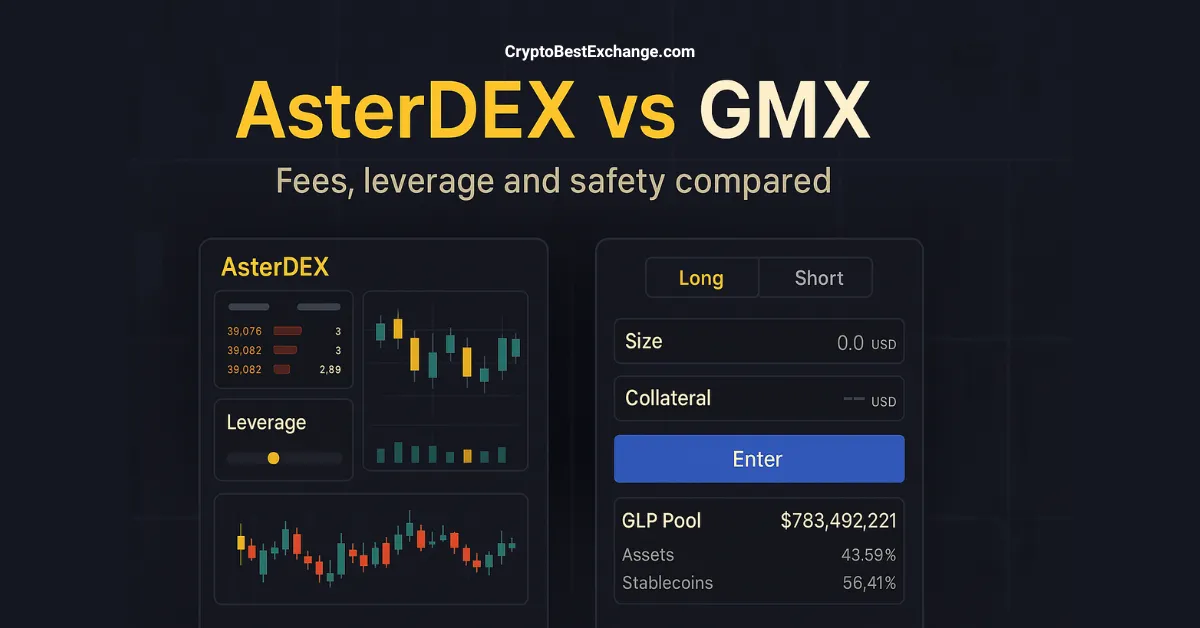
Table of Contents
AsterDEX vs GMX: Quick Comparison at a Glance
| AsterDEX | GMX | |
|---|---|---|
| Core focus |
AsterDEX Perp-first DEX
Perpetual futures, 1001x “degen” rail, spot and yield-native collateral.
|
GMX Perp & swap DEX
On-chain perps and swaps with pooled liquidity via GLP.
|
| Networks | EVM chains such as BNB Chain and other L2s (multi-chain rollout). | Primarily Arbitrum and Avalanche (GMX v1 & v2 deployments). |
| Max leverage | Up to 1001x on selected pairs via 1001x mode; high but more conventional leverage on Perpetual Pro. | More conservative leverage caps (typically up to ~50x on major pairs), aimed at reducing extreme liquidation risk. |
| Main products | Perpetual Pro, 1001x mode, spot markets, USDF / asBNB collateral and Aster Earn. | Perpetual swaps, spot-style swaps, GMX staking, GLP index-style liquidity pools. |
| Yield layer | Yield-bearing USDF and asBNB, CeDeFi strategies via Aster Earn, incentives for high-volume traders and referrers. | Fee revenue share to GMX stakers and GLP holders, esGMX incentives and ecosystem points programs. |
| Tokens | ASTER as ecosystem token, plus USDF / asBNB as yield-native collateral assets. | GMX as governance and fee-share token, GLP as the pooled liquidity index. |
| Fee profile | Low base maker/taker fees on Perpetual Pro, dynamic closing fees on 1001x tied to PnL, plus standard network execution costs. | Swap and execution fees on each trade, plus borrowing and funding mechanics baked into the GLP-based perp model. |
Both DEXes let you trade long and short without giving up custody. However, if you’re new to longs and shorts , it’s worth understanding the basics of how leveraged positions, funding and liquidations work before committing serious capital on either platform.
Products and User Experience
How AsterDEX and GMX Handle Trading & Order Types
Even though AsterDEX and GMX both sit in the “perpetual DEX” bucket, the way they feel when you trade on them is quite different.
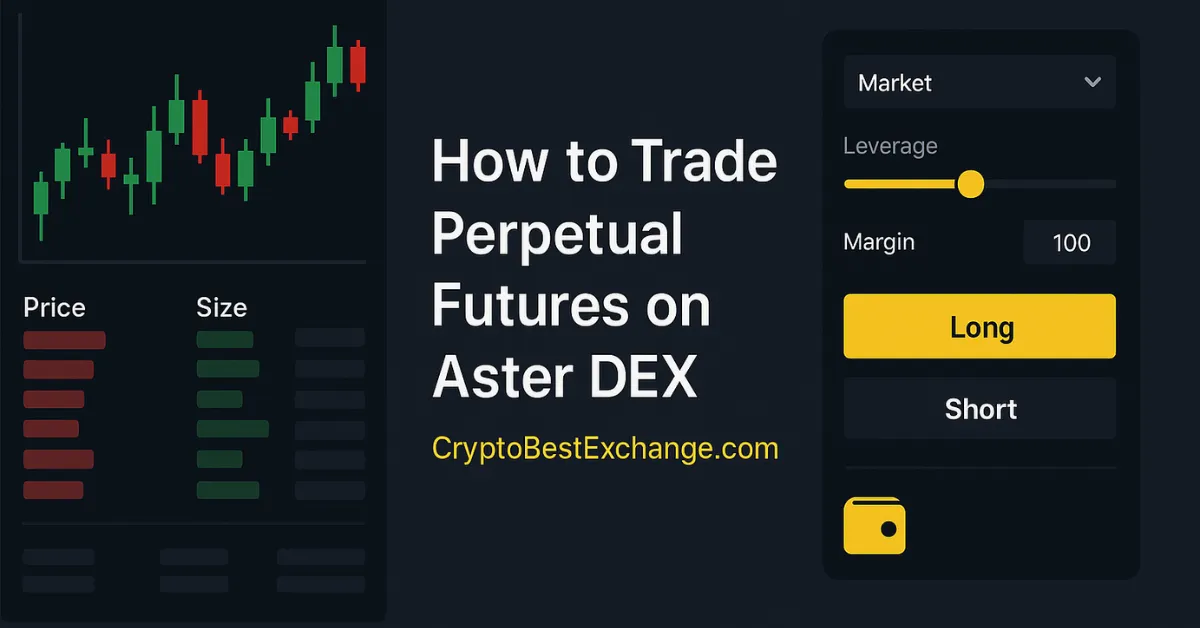
On AsterDEX, the core experience revolves around a CEX-style orderbook interface, especially in Perpetual Pro. You get a familiar layout: price chart, live orderbook, recent trades, position panel and a ticket where you can adjust leverage, margin mode and order type. For active derivatives traders who are used to Bybit/Binance-style layouts, AsterDEX feels relatively natural: you place limit orders into the book, hit market orders for quick entries, and use stop or take-profit style orders (where available) to automate exits. On top of that, the separate 1001x mode adds a more experimental panel focused on ultra-high leverage, with fewer controls but very clear emphasis on risk and PnL-linked closing fees.
GMX is more “DeFi-native” in its presentation. Instead of a traditional orderbook, you interact with a swap-style perp ticket: you choose long or short, size, leverage, and the protocol routes the trade against pooled liquidity (GLP) rather than a visible orderbook. The interface is quite clean and approachable, but it doesn’t show the same depth ladder that orderbook traders are used to. You still get essential controls – market and limit-style entries, configurable slippage tolerance and clear liquidation levels – but the overall feel is closer to an on-chain perp swap than a full-blown CEX clone.
In short:
- If you want something that looks and behaves like a classic orderbook futures venue with more advanced controls and hidden orders, AsterDEX leans in that direction.
- If you prefer a simpler, swap-like interface where the protocol handles routing against a pooled index of liquidity, GMX feels more streamlined, especially for traders already comfortable with DeFi swaps.
Both platforms support the core set of order types (market/limit and some form of stop logic), but the way they expose depth and routing is what makes the user experience feel different.
Supported Markets and Liquidity Depth
When you look past the UI, the next big question is what you can actually trade and how deep the markets are.
On AsterDEX, the listing strategy leans toward being a multi-chain perp hub with a mix of:
- Major pairs like BTC and ETH
- High-liquidity large-cap altcoins (L1/L2, DeFi, AI, etc.)
- Select meme and narrative coins when there is sufficient on-chain interest and volume
Perpetual markets are the main focus, with spot markets and yield-native collateral assets (USDF, asBNB and others) built around them. Because AsterDEX is newer, liquidity is still concentrating around a smaller set of flagship markets, especially BTC/ETH and a handful of high-volume alts. Depth on those core pairs can be competitive, but long tail markets may feel thinner and more sensitive to order size and slippage.
GMX, by contrast, has had more time to accumulate TVL and volume, especially on Arbitrum. Its perp markets are backed by pooled liquidity (GLP), which aggregates a basket of assets into a single index-style pool. For traders, that means:
- Fewer total listed markets than a hyper-aggressive listing CEX,
- But generally solid depth on supported majors (BTC, ETH and key large caps),
- With price impact determined by pool composition and open interest, rather than a visible orderbook.
On the spot/swap side, GMX focuses on core pairs and blue chips that fit cleanly into its GLP basket, rather than listing every trend coin. This can feel more constrained if you’re chasing very niche perps, but it can also make liquidity quality more predictable on the pairs that do exist.
From a practical standpoint:
- AsterDEX offers strong flexibility for traders who want multi-chain access, high leverage and a mix of perps, spot and yield-native collateral, with depth concentrating on headline markets.
- GMX offers a more mature liquidity profile on a tighter set of pairs, where most volume flows through its GLP-backed perps and swaps, and depth is reinforced by long-standing TVL and fee-sharing incentives.
If your strategy relies on fast execution in BTC/ETH and a few high-cap alts, both platforms can work; if you need exotic narratives and ultra-high leverage, AsterDEX will usually offer more variety, while GMX leans toward depth and stability on a more curated market list.

Fees, Funding and Slippage
Perpetual Trading Fees on Aster DEX
On AsterDEX, perpetual traders face two main cost layers: trading fees and funding payments.
In Perpetual Pro, the platform uses a classic maker/taker model. Limit orders that rest on the book are treated as makers and usually pay a lower fee, while market orders and aggressively priced limits are takers and pay a slightly higher rate. Fees are charged both on entry and exit, calculated as a percentage of the notional size of your position, so high-frequency scalpers need to pay close attention to their round-trip cost.
The separate 1001x mode adds a twist. In more conservative configurations, you pay an opening and closing fee similar to a normal perp venue (plus a small execution cost for on-chain settlement). In the more aggressive “degen” configuration, AsterDEX may charge little or nothing on entry, and instead apply a dynamic fee on closing that scales with your realized PnL. This structure makes very small or losing trades relatively cheap, but big winners can face noticeably higher closing costs, which you need to factor into your strategy.
Across both modes, your effective fee on AsterDEX is a blend of base maker/taker rates, the specific 1001x configuration you use, and any VIP or referral discounts you unlock through volume and ASTER holdings.
Perpetual Trading Fees on GMX
GMX approaches perp fees through its GLP-based liquidity model rather than a traditional orderbook.
When you open or close a position on GMX, you pay:
- A trading fee on each transaction (opening and closing),
- An implicit borrowing cost that depends on how much long and short open interest is sitting against the GLP pool,
- And, for some markets, a separate funding component that helps keep perp prices in line with the underlying.
Instead of fees flowing to a central entity, a significant portion of this revenue is shared with GMX stakers and GLP holders, which is why fee schedules are designed to sustain the pool and reward LPs. From a trader’s perspective, that means your visible fee line is only part of the picture: the balance between long and short demand, and the composition of the GLP pool, influence how expensive it is to hold certain positions over time.
Overall, GMX tends to feel fee-stable and predictable on major pairs, especially for mid- to long-term positions, but intraday traders still need to watch how borrowing and funding dynamics evolve as open interest shifts.
Funding, Slippage and Price Impact
Once you add funding, slippage and price impact to headline fees, the real cost of trading on AsterDEX and GMX starts to diverge depending on your style.
On AsterDEX, funding works in a familiar way: when the perpetual price trades above the spot index, longs typically pay funding to shorts; when it trades below, the flow tends to reverse. If you hold positions for many hours or days, these periodic payments can quietly outweigh your entry and exit fees, especially in crowded, one-sided markets. Slippage is driven by the visible orderbook and on-chain liquidity, so large market orders or thinly traded pairs will see more price impact. Using limit orders on Perpetual Pro and sticking to deeper markets can significantly reduce this hidden cost.
On GMX, price impact is more tightly linked to GLP pool composition and open interest. When many traders are leaning in the same direction, borrowing costs and effective funding can rise as the protocol rebalances incentives between traders and LPs. Slippage is less about a visible ladder of bids and asks and more about how far your trade moves the pool price relative to its current state. For moderate-size positions in the most liquid pairs, this can be quite efficient; for large size or exotic markets, the impact can be noticeably higher.
If your main priority is finding cheap ways to enter crypto with minimal friction on the spot side – for example, building core BTC or ETH exposure before trading perps – it can be worth combining either of these perp platforms with traditional spot venues or dedicated low-cost bridges, as covered in our guide to cheap ways to buy Bitcoin and get into crypto.
In practice:
- Short-term, high-frequency traders will feel the difference in slippage and fee rounding more strongly, and may prefer the venue where their main pairs show the deepest effective liquidity.
- Swing and positional traders should focus more on funding patterns and borrowing costs, choosing the platform where their typical holding period and direction are structurally less penalised.
Leverage Limits, Liquidation Rules and Risk Controls
Maximum Leverage and Margin Models
If you care about leverage, AsterDEX and GMX sit at opposite ends of the spectrum.
On AsterDEX, the headline is simple:
- Perpetual Pro offers “normal” high leverage that should be more than enough for most directional traders. Exact caps vary by pair, but the design is to give you a familiar futures range for BTC, ETH and major alts.
- The separate 1001x mode pushes things into ultra-high-leverage territory on a small set of pairs. It’s explicitly designed for very small, highly speculative positions rather than your main account balance.
A key difference is how margin is handled. Perpetual Pro is built around classic cross and isolated margin:
- Isolated margin lets you confine risk to a single position. If it blows up, it shouldn’t take the rest of your account with it.
- Cross margin uses your overall balance to back positions, which can reduce liquidation risk on one trade but expose more of your capital if several positions move against you at once.
On GMX, leverage is more conservative but tightly integrated with its pooled GLP margin model. Your collateral sits in a shared pool that backs both longs and shorts; the protocol manages risk by adjusting borrowing and funding costs rather than offering extreme leverage:
- Typical leverage caps are much lower than 1001x, generally aiming to keep liquidations and pool stress under better control.
- Margin is effectively pooled at the protocol level rather than isolated per position in the same way as CEX-style futures engines, which is one reason GMX doesn’t chase ultra-degen leverage.
So in broad terms:
- AsterDEX gives you more raw leverage and configuration options (including cross/isolated and a 1001x rail).
- GMX offers a more constrained, pool-based margin environment, implicitly nudging traders toward sizing and leverage levels that are less likely to blow up the liquidity pool.
Liquidation Mechanics and Built-In Risk Controls.
Leverage only matters insofar as you understand how and when you get liquidated.
On AsterDEX, the logic is closer to a traditional futures engine:
- Your maintenance margin is calculated from position size, leverage, and underlying risk parameters for each market.
- If your equity drops below that maintenance level (because price moves against you or fees/funding eat into margin), the system can liquidate some or all of your position.
- In high-leverage configurations – especially in or near the 1001x mode – even tiny price moves can be enough to trigger liquidation, and there may be limited room to add margin or adjust before the engine steps in.
Risk controls are mostly in the trader’s hands: you decide isolated vs cross, position size, leverage level and stop placement. The platform provides tools; you decide how aggressively to use them.
On GMX, liquidations are tied more tightly to the oracle price and GLP pool health:
- The protocol relies on external price feeds to determine a mark price and check whether your remaining collateral is sufficient to cover unrealised losses plus fees.
- When your position becomes undercollateralised, GMX closes it out against the pool to prevent bad debt and protect LPs.
- Because the system is built on pooled liquidity, the liquidation logic is designed to balance trader fairness and pool solvency, rather than maximising leverage.
In both cases, the main things that can catch high-leverage traders off guard are:
- Fast wicks or gaps on thin liquidity,
- Oracle or pricing anomalies,
- And stacking too many positions or products on the same volatile asset.
AsterDEX gives you more knobs to turn; GMX constrains the system more at the protocol level. Neither removes the need for strict position sizing and clear invalidation levels.
Which Platform Is Safer for High-Leverage Traders?
“Safer” in the context of high leverage is always relative – you’re still playing a high-risk game on both platforms – but the risk profile of AsterDEX vs GMX is different.
- If you judge risk primarily by maximum leverage and complexity, AsterDEX is clearly more aggressive. The 1001x rail, yield-bearing collateral and multi-chain deployment all add moving parts. Used carefully with small sizes, that can be powerful; used recklessly, it can accelerate losses very quickly.
- If you prioritise conservative leverage caps and a more battle-tested pool model, GMX will usually feel safer. You sacrifice some upside in terms of raw gearing, but you gain a framework that is structurally less tolerant of “casino-level” trades.
For genuinely high-leverage traders, the safer option is less about choosing one protocol over the other and more about how you integrate them into your overall plan:
- Use moderate leverage (e.g. low double-digits) on your main directional positions,
- Treat ultra-high-leverage rails like AsterDEX’s 1001x as small side bets with predefined loss limits,
- Keep only a portion of your capital actively deployed on any single DEX, and spread the rest across safer venues, spot holdings or yield strategies that fit your risk tolerance.
If you want to see where AsterDEX and GMX might fit inside a broader crypto portfolio – alongside spot, structured products and other derivatives – it’s worth looking at your futures trading as just one component of a bigger plan, like the frameworks discussed in our guide to long-term crypto investment strategies for 2026.
Yield, Tokens and Long-Term Incentives
ASTER Token, USDF and Aster Earn
On the AsterDEX side, the incentive layer is built around a stack of native tokens and yield-bearing collateral rather than a single reward coin.
At the top sits the ASTER token, which underpins most of the long-term incentives on the platform. Holding and using ASTER can influence things like VIP tiers, fee discounts and access to special campaigns, so for active traders it’s not just a speculative asset – it’s part of how you push your effective fee rate down over time.
Alongside ASTER, AsterDEX leans heavily into yield-native collateral:
- USDF is designed as a yield-bearing stablecoin, so instead of parking idle USDT in your wallet, you can convert into USDF and let it earn yield through curated strategies.
- asBNB (and similar “as-” assets) represent BNB or USDF that’s been deposited into Aster’s yield system, so your collateral can still earn while you’re using it as margin.
These pieces are tied together by Aster Earn, the protocol’s CeDeFi-style yield layer. You can deposit assets into pre-selected strategies, receive yield-bearing tokens in return, and then often use those tokens as margin for perps. For a trader, that means your capital doesn’t have to sit idle between setups – but it also means you’re stacking market, leverage and strategy risk on the same pool of funds.
In short, AsterDEX’s token and yield design is geared toward traders who want to squeeze as much efficiency as possible out of their margin, at the cost of higher structural complexity.
GMX Token, GLP and Other Yield Options
The GMX ecosystem is more minimalist but very clear about who gets paid and why.
The core token is GMX, which acts as both a governance and fee-sharing asset. When you stake GMX, you typically receive a mix of:
- A cut of the protocol fees paid by traders,
- Additional incentives (such as escrowed GMX or points) that encourage long-term staking.
On the liquidity side, GMX introduced GLP, an index-style token representing a basket of assets that backs the perp and swap markets. When LPs mint GLP, they’re effectively:
- Providing collateral the protocol uses to take the other side of trades,
- Earning a significant portion of fees and funding paid by leveraged traders,
- Taking on inventory and directional risk from that basket.
The result is a relatively straightforward flywheel:
- Traders pay fees and funding into the system.
- Stakers and GLP holders receive a share of that revenue.
- Long-term LPs are incentivised to keep capital parked, which supports liquidity and tight execution for traders.
Compared with AsterDEX, GMX’s incentive design is less about yield-native margin tricks and more about splitting the economics of the exchange between traders, token stakers and GLP LPs in a transparent way.
Which Ecosystem Rewards Active Traders More?
From a pure incentive design perspective, both AsterDEX and GMX can be attractive – but they reward different behaviours.
For high-volume traders:
- AsterDEX tries to win on capital efficiency and stacked incentives: yield-bearing collateral (USDF, asBNB), VIP tiers linked to volume and ASTER holdings, referral commissions and campaigns. If you trade often, optimise your margin usage and engage with the ecosystem, your effective fee rate can drop sharply below the headline schedule.
- GMX focuses more on stable execution costs and long-term fee-sharing. Traders don’t usually receive a large direct rebate (unless part of specific campaigns), but they benefit from the liquidity and depth that GLP incentives create. If you’re also willing to be a GMX or GLP holder, you can “recycle” part of your trading spend back to yourself via staking.
For LPs and long-term ecosystem participants:
- GMX’s GMX + GLP combo is often easier to understand: you provide liquidity or stake tokens and receive a share of protocol fees, with risks clearly tied to pool composition and trader flows.
- AsterDEX offers more combinatorial yield routes (USDF, asBNB, Aster Earn, ASTER incentives), which can be powerful but demand more ongoing monitoring and risk management.
If your goal is to be an active trader first and an ecosystem farmer second, AsterDEX arguably offers more levers to push your costs down – as long as you’re comfortable with the extra moving parts. If you prefer a simpler, more battle-tested revenue-sharing model and are happy to hold staking/LP positions over longer periods, GMX’s token and GLP structure may feel more straightforward and conservative.
Choosing Between AsterDEX and GMX
When AsterDEX Makes More Sense
AsterDEX is the better fit if you’re the kind of trader who wants to squeeze as much as possible out of leverage, capital efficiency and incentives.
It makes more sense if:
- You actively use high leverage and want the option to scale from “normal” perp leverage up to a separate 1001x rail for tiny, high-conviction bets.
- You like the idea of yield-native collateral – using assets like USDF or asBNB so that your margin can earn yield in the background instead of sitting idle.
- You prefer a CEX-like, orderbook-style interface with visible depth, maker/taker logic and more advanced order tools.
- You are comfortable operating across multiple EVM chains, bridging capital and managing gas and network switches.
In this profile, AsterDEX is essentially a toolbox for aggressive, on-chain futures traders: powerful if you already have strong risk management and know how to run structured strategies, overkill if you are still learning the basics of leverage and PnL swings.
For a deeper look at fees, liquidity and tokenomics, see our full AsterDEX review.
When GMX Might Be the Better Choice
GMX tends to be the better choice if you care more about stability, track record and a simpler mental model than about pushing leverage and yield to the absolute limit.
GMX is likely a better fit if:
- You prefer moderate, clearly constrained leverage over headline-grabbing 1001x settings.
- You value a longer operational history and a large, battle-tested community of traders, stakers and LPs.
- You like the GLP pooled-liquidity model, where the relationship between traders and LPs is transparent and fee sharing is straightforward.
- You’re happy with a clean, swap-style perp interface and don’t necessarily need a full CEX-style orderbook view.
For many traders, GMX feels like a DeFi-native “workhorse”: it may not be as flashy in terms of features or leverage, but its design encourages more sustainable behaviour from both traders and LPs, which can be a good thing if you’re planning to keep meaningful capital on-chain over time.
Can You Use Both? Using AsterDEX and GMX in a Diversified Setup
You don’t need to stick with a single platform. In practice, many advanced traders will get the best of both worlds by splitting their capital and roles across AsterDEX and GMX.

A few ways to think about it:
- Treat AsterDEX as your “high-octane” trading venue: use Perpetual Pro for your main setups with moderate leverage, keep 1001x strictly for tiny, predefined-risk bets, and experiment with yield-native collateral only on a portion of your margin.
- Treat GMX as your “core on-chain perp + yield base”: run more conservative perp positions there, stake some GMX, and consider allocating a portion of your long-term crypto stack into GLP if you’re comfortable with the underlying basket risk.
- Keep a separate bucket of capital off both platforms – in spot, stablecoins or other investments – so you’re never fully dependent on a single DEX or a single risk model.
If, while doing this, you realise that you still feel more comfortable with centralized exchanges for the bulk of your activity, you can always lean on CEXs for most of your volume and treat AsterDEX and GMX as specialised satellite venues – and look at curated options in our guide if you prefer CEX instead of DEX.
AsterDEX vs GMX FAQ (2026 On-Chain Perp DEX Questions)
The “cheapest” platform depends on your trading style. On AsterDEX, you typically face low maker/taker fees on Perpetual Pro plus dynamic closing fees on the 1001x rail, while GMX charges per-trade fees plus borrowing and funding costs tied to its GLP pool. For short-term traders, slippage and price impact on your main pairs can matter more than the headline fee line. For swing traders, funding and borrowing costs over time often decide which venue is actually cheaper in practice.
GMX has a longer track record, a large base of stakers and LPs, and a conservative leverage model, which many traders see as better suited to long-term capital. AsterDEX is newer but emphasises audits, on-chain settlement and risk disclosures, while also adding ultra-high-leverage and yield-native features. In both cases, you still face smart contract, oracle and market risk, so it’s wise to avoid concentrating your entire portfolio on a single DEX and to size deposits according to your own risk tolerance.
If you want maximum headline leverage, AsterDEX clearly offers more. Perpetual Pro already supports high leverage, and the separate 1001x mode can push selected markets to extreme levels for small, speculative positions. GMX deliberately keeps leverage more conservative to protect its GLP pool and reduce the probability of extreme liquidations. Just because AsterDEX allows higher leverage doesn’t mean you should use it on your full account balance — most traders are better off in a moderate range with clear invalidation levels.
Yes. Many advanced traders combine both platforms in a single framework. One common approach is to treat AsterDEX as the “high-octane” venue for more aggressive or short-term perp trades, and GMX as the “core” venue for more conservative positions, staking and GLP-based yield. You can also hedge exposure across the two, spread counterparty and protocol risk, and keep part of your capital on CEXs or spot venues for fiat on/off-ramps and simpler execution.
Still undecided between AsterDEX, GMX and other perp platforms? Stay ahead of new listings, fee rebates and on-chain trading opportunities by joining the CryptoBestExchange Telegram: https://t.me/cryptobestexchangecom.
 Crypto Trading Platforms & Apps
 Best Crypto Trading Apps & Platforms
 Crypto Futures & Leverage Trading
 Buying & Selling Crypto
 Automated & Software Trading